

Why data center growth requires smarter energy management

Artificial intelligence is reshaping the energy demands of data centers. As computing equipment becomes more power-intensive, operators face a dual challenge: securing sufficient electricity to support growing workloads while managing increasingly complex interactions between power supply, storage, cooling, and backup generation. Maintaining reliable operations is becoming as much a question of how these systems work together as how much electricity is available.
U.S. data centers accounted for approximately 4.7% of the nation’s electricity consumption in 2024, a share projected to reach 11.8% by 2030 in Lawrence Berkeley National Laboratory’s reference case. Demand is also becoming more concentrated. According to the International Energy Agency, a single advanced server rack could have peak power demand equivalent to that of 65 U.S. households by 2027, placing additional pressure on electrical distribution and cooling systems. Meeting these demands will require substantial investment in power generation, storage, and grid infrastructure. However, new facilities and grid connections often take years to develop, leaving operators with a more immediate challenge: how to make better use of existing electrical capacity without compromising reliability.
Addressing that challenge requires more than managing individual systems efficiently. It calls for a coordinated approach to how electricity is supplied, stored, and consumed across an increasingly complex data center environment. This is where AI-driven energy management systems (EMS) are beginning to play a more significant role, helping operators anticipate changing conditions, coordinate interconnected equipment, and optimize the use of available power.
From monitoring to intelligent energy orchestration
The shift toward more intelligent energy management is not simply about automating existing processes. It is about making decisions across interconnected systems, where optimizing one component can affect the performance and reliability of others.
Traditional energy management software has supported monitoring, forecasting, and optimization. AI is extending these capabilities by identifying potential faults and anticipating changing conditions, while agentic AI introduces the ability to translate recommendations into automated actions within defined operational limits and subject to human approval. This emerging approach is reflected in EnergyFluo™, an award-winning agentic AI EMS developed by Hanwha Group company TransGrid Energy. The platform combines AI-driven analysis, optimization, and fault detection with physics-based equipment models and digitized operating procedures to identify potential issues and coordinate energy management across individual facilities and multiple sites.
Consider a data center preparing for colder weather. As outdoor temperatures fall, cooling requirements may decline, creating an opportunity to reduce electricity consumption. EnergyFluo could anticipate this change, recommend reducing chiller operation, and execute the adjustment following operator approval, within established equipment limits.
The potential benefits extend across data center operations. By identifying equipment issues earlier, coordinating energy resources, and reducing the need for manual adjustments, AI-driven management could improve operational efficiency. In facilities with fixed electrical limits, reducing unnecessary consumption by supporting equipment could also leave more capacity available for computing, provided reliability requirements are maintained.
As Dr. Youngchoon Park, CEO of TransGrid Energy, explained, EnergyFluo “orchestrates grid, storage and on-site generation as one system and optimizes the load behind them, so operators can put more megawatts to work for IT and run their entire fleet from one intelligent view.”
As AI takes on a more active role in managing critical infrastructure, safeguards become increasingly important. The technology behind EnergyFluo was among the first AI-enabled products globally to receive certification from UL Solutions under UL 3115, an outline of investigation for the safety of AI-based products, in March 2026. The evaluation examined safeguards including operator approval, explainability, audit trails, and rollback capabilities, reflecting the importance of maintaining human oversight as AI takes on a more active role in critical operational decisions.
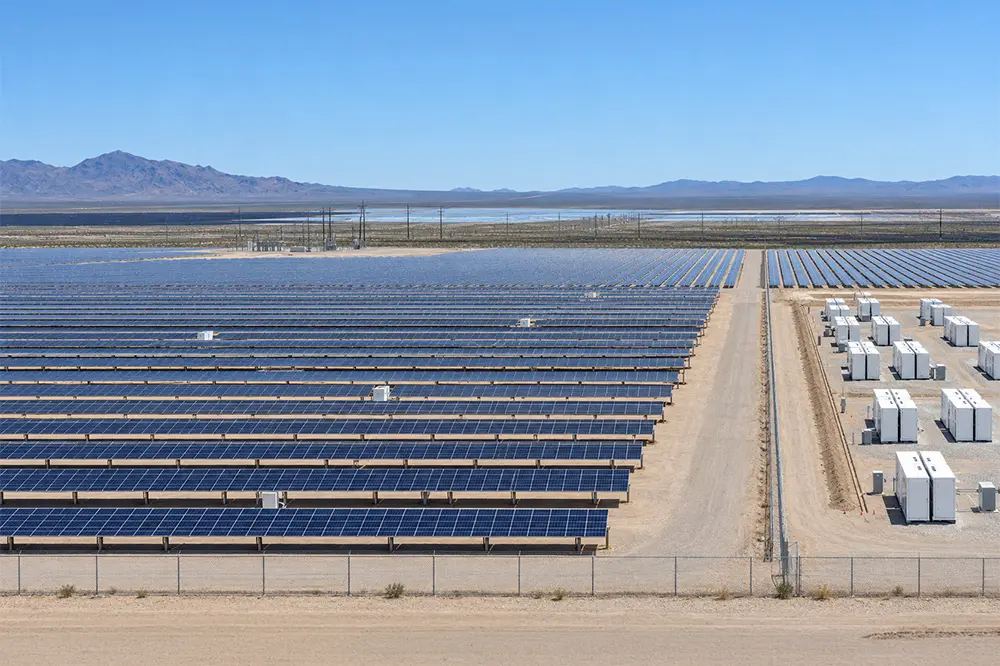
TransGrid Energy’s Atlas project in La Paz County, Arizona, U.S.
Connecting intelligence with energy infrastructure
Software alone cannot overcome constraints on electricity supply. Data centers still depend on generation, storage, and grid infrastructure, making the integration of physical assets and intelligent management systems increasingly important. This connection between infrastructure and software is also reflected in TransGrid Energy’s approach. Beyond developing EnergyFluo, the company develops and operates power generation and battery storage assets, bringing together capabilities that address both electricity supply and how that supply is managed.
Connecting physical infrastructure with intelligent software presents another challenge: interoperability. Equipment from different manufacturers may use different terminology and data formats, making it difficult for management software to interpret measurements consistently or understand how systems are connected. A temperature reading, for example, is more useful when software can identify which equipment it relates to and how that equipment interacts with the wider facility.
Common data frameworks can help bridge these differences. WattSchema, an open-source ontology used in Hanwha’s data center energy management work, gives equipment, measurements, and the relationships between them a shared vocabulary. Software can then interpret readings consistently across equipment from different manufacturers, providing a foundation for more coordinated energy management.
A planned nationwide network of distributed data centers developed by Prime Group, a real estate investment firm, in collaboration with Hanwha provides an example of how these elements could come together. The project aims to use existing properties and available electrical capacity to support AI computing, with TransGrid Energy providing additional generation and storage where needed.
At one location in Georgia, WattSchema integration has begun as equipment such as chillers and generators is installed. The site is also leveraging EnergyFluo, combining physical energy infrastructure with software designed to coordinate operations across multiple sites.
As power availability becomes an increasingly important constraint on AI growth, the value of energy infrastructure may depend not only on how much electricity it can supply, but also on how effectively that power can be allocated and managed. The ability to coordinate generation, storage, grid supply, and facility loads could increasingly influence how much computing capacity existing energy systems can support.
This content was produced in partnership with Forbes BrandVoice.
Related Content




Get the latest news about Hanwha, right in your inbox.
Fields marked with * are mandatory.
- Non-employee
- Employee