

Qcells achieves an industry-first safety benchmark for AI energy management
• Qcells has become the first company certified under UL 3115, the industry’s first AI safety evaluation framework for mission-critical energy management systems (EMS) in data centers.
• The framework establishes a global benchmark for evaluating AI-driven control of power infrastructure, including battery dispatch, distributed energy resources (DERs), and grid-interactive systems.
Artificial intelligence is becoming a central tool in modern data centers. From forecasting demand to optimizing power consumption, some 58% of data center operators see AI as a key driver of improved facility performance.
But while operators increasingly rely on AI for optimization, many still view autonomous systems capable of dispatching batteries or adjusting power flows as introducing an unacceptable level of risk. In mission-critical environments like data centers, where even brief disruptions can carry significant operational and financial consequences, questions around safety and reliability remain central to adoption.
As data center infrastructure grows more complex, these concerns are intensifying. Today, facilities must simultaneously manage grid pricing signals, renewable intermittency, battery state-of-charge limits, generator constraints, and strict redundancy requirements — variables that are increasingly difficult to coordinate through manual oversight or static rule-based systems alone.
Energy management systems (EMS) and operational technologies (OT) can help automate these processes. However, until recently the industry has lacked a formal benchmark to evaluate the safety of AI-driven systems overseeing such complex power infrastructure.
In late 2025, UL Solutions, a global leader in applied safety science, established UL 3115 — a secure evaluation framework designed to assess AI-based systems operating in critical infrastructure environments. Qcells has since become the first company certified under this new framework for a component of its own AI-driven data center EMS.
AI control vs. AI optimization: What changes?
AI has been broadly accepted for its role in system optimization. Predictive maintenance tools, sensor analytics, and demand forecasting systems are deployed across sectors to support decision-making. However, they generally remain advisory, with humans ultimately deciding which actions to take.
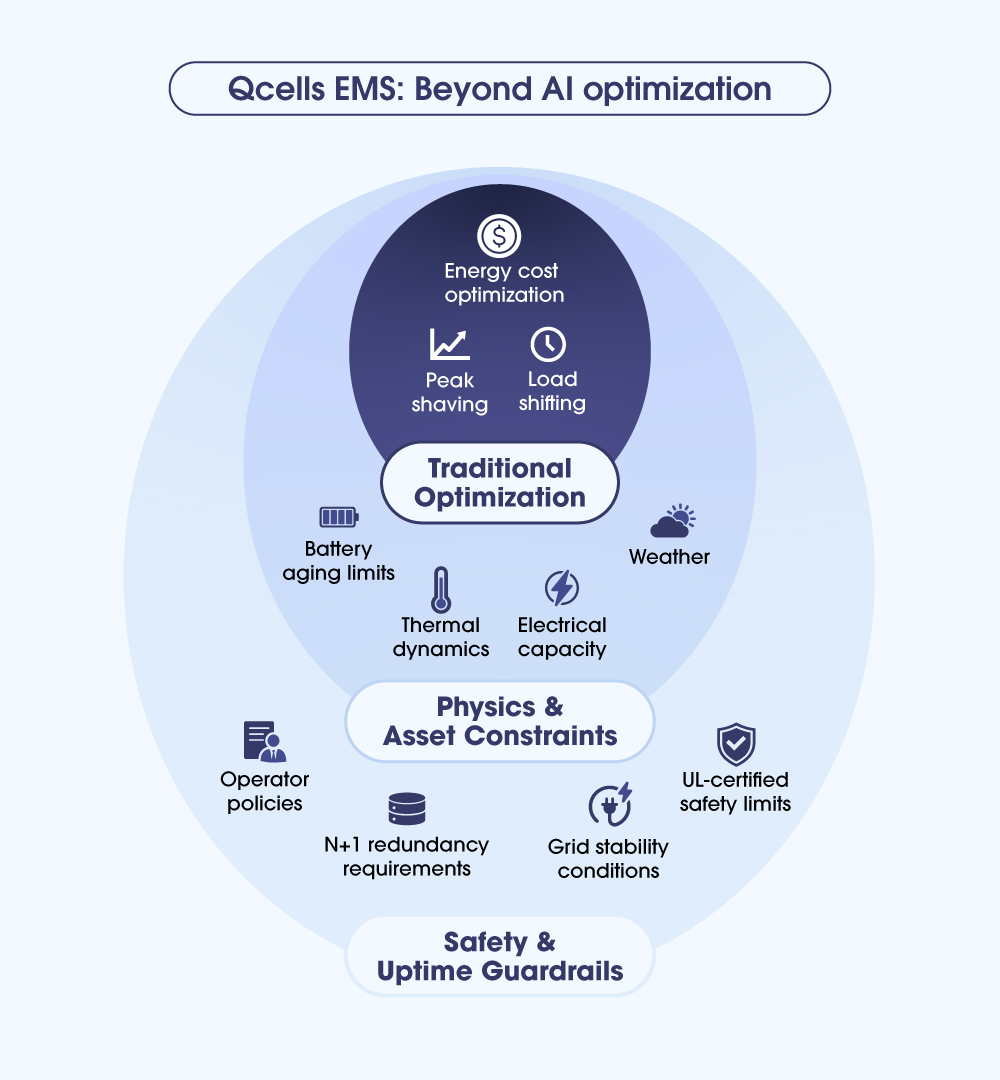
In data centers, reliability thresholds must be far stricter than in conventional IT systems. When AI begins dispatching batteries, shifting loads, or coordinating distributed energy resources in real time, higher operational consequences are introduced. AI-driven EMS must demonstrate predictable and safe behavior, maintaining uptime and infrastructure integrity under a variety of operating conditions.
Developed for data center environments, Qcells’ EMS is a platform that enables human and AI agent collaboration on distributed energy resources such as renewables, battery storage, and grid connections into a unified operational environment. Within this architecture, strict safety and uptime guardrails enforce operating limits, verify actions before execution, and provide fail-safe fallbacks that protect critical loads.
Despite these safeguards, a lack of industry-standard verification of how AI-driven energy management systems behave under real-world operating conditions has remained a barrier to their adoption. Established by UL Solutions, this new framework will help validate EMS safety and provide operators with independent assurance.
Defining a safety benchmark for AI in power systems
UL 3115 establishes criteria for evaluating AI-based systems used in mission-critical infrastructure. The framework assesses areas such as functional safety, transparency of decision logic, cybersecurity protections, and system performance during abnormal or degraded operating conditions.
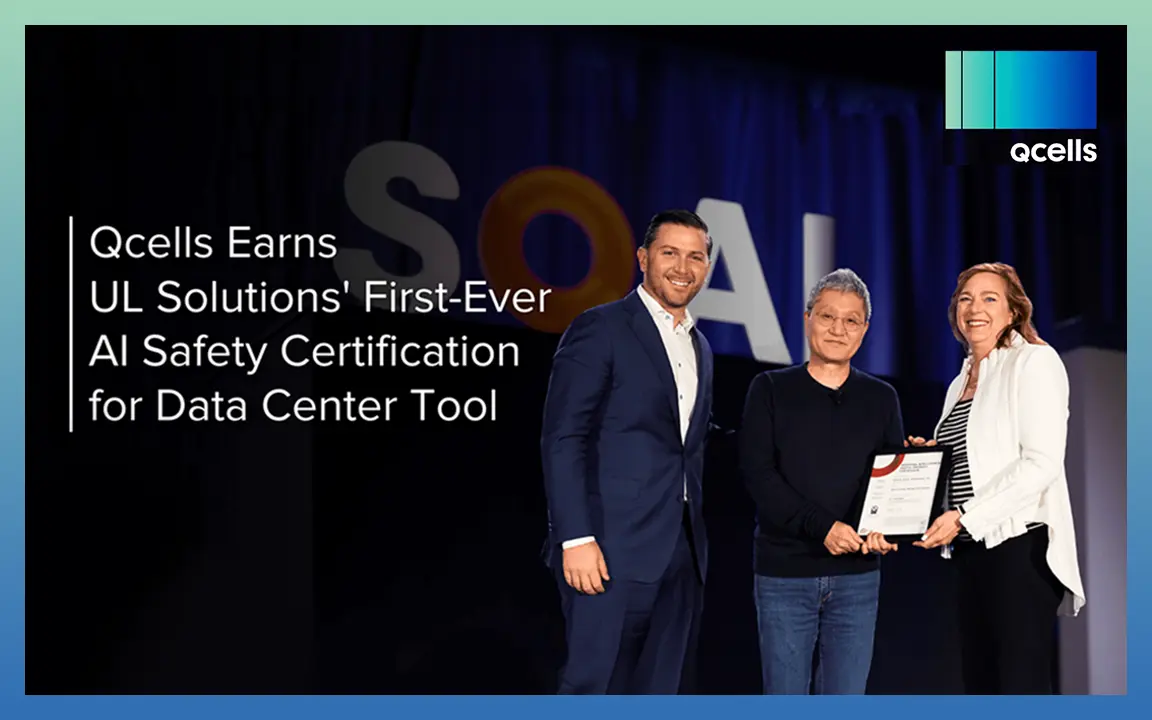
Qcells was the first to achieve this certification for a core AI-driven control component within its EMS architecture. As part of the certification process, UL Solutions evaluated the system using simulated data center operating scenarios to confirm that it performs safely across a range of conditions.
“This certification shows that human and AI-agent energy optimization collaboration can be safe and is ready for data center operations,” said Dr. Youngchoon Park, Head of the Grid and Energy Services Business Unit at Qcells. “It offers a credible path to scale while demonstrating our commitment to creating resilient, reliable, AI-enabled platforms.”
Enabling deployable, infrastructure-grade AI
For data center operators, deploying autonomous energy systems requires more than technological capability. Systems responsible for managing power, cooling, and grid interaction must operate reliably within some of the world’s most critical infrastructure. As AI increasingly moves from analytics into operational control, confidence in how these systems perform under real-world conditions becomes essential.
Standards like UL Solutions’ UL 3115 help address that challenge. By validating that autonomous energy management systems can operate within defined safety boundaries, the framework demonstrates that AI control can meet the reliability expectations of high-stakes environments while still delivering the benefits of intelligent optimization.
By becoming the first to achieve UL Solutions’ AI safety certification, Hanwha is helping to demonstrate how autonomous energy systems can be deployed safely to support a more energy-secure future.
Related Content

Get the latest news about Hanwha, right in your inbox.
Fields marked with * are mandatory.
- Non-employee
- Employee